
On 2 September 2026, researchers led by University College Dublin reported the recovery of ancient sheeppox virus DNA from archaeological animal remains and historic manuscripts, including some of Europe’s best-known medieval documents. The work pushes direct molecular evidence for sheeppox back thousands of years — and demonstrates something much broader.
An animal that died centuries or millennia ago can leave behind more than its own DNA. Preserved within its tissues may be fragments of the organisms that infected it, creating a biological archive through which we can begin reconstructing the history of disease itself.
For The BioChain, that is particularly interesting. Our planned Ancient BioChain project begins with the genomic information preserved in ancient biological material. In Stage 2, we intend to extend that concept to ancient pathogens: examining how pathogen DNA associated with archaeological remains can help reconstruct the diseases that affected animals and people in the past. Sheeppox provides an extraordinary example of what that approach can reveal.
Sheeppox is caused by sheeppox virus (SPPV), a member of the genus Capripoxvirus alongside goatpox virus and lumpy skin disease virus. It remains an important livestock disease today. In affected sheep it can cause fever, characteristic skin lesions, internal disease and death, and outbreaks can impose substantial economic costs through mortality, reduced production, damaged hides and wool, and restrictions on livestock movement and trade.[4][5]
Within the European Union, sheep pox and goat pox are Category A diseases under the Animal Health Law, meaning outbreaks trigger immediate eradication measures.[5]
But the disease is certainly not new. Historical descriptions have long suggested that pox-like diseases affected sheep in antiquity and the medieval period — but written descriptions cannot necessarily tell us which pathogen caused an historical disease. Ancient DNA changes that.
Louis L’Hôte and colleagues investigated archaeological and historical biological material from across Eurasia and identified sheeppox virus in specimens extending from the Bronze Age through medieval and Early Modern Europe. The researchers report 21 novel ancient SPPV genomes, with evidence extending back approximately 3,700–3,800 years — taking the molecular history of this livestock pathogen deep into the Bronze Age.[1]
Some of the oldest evidence came from sheep teeth recovered from archaeological contexts on the Eurasian steppe — perhaps where we might expect ancient pathogen research to look. Other viral genomes came from somewhere much less obvious: books.
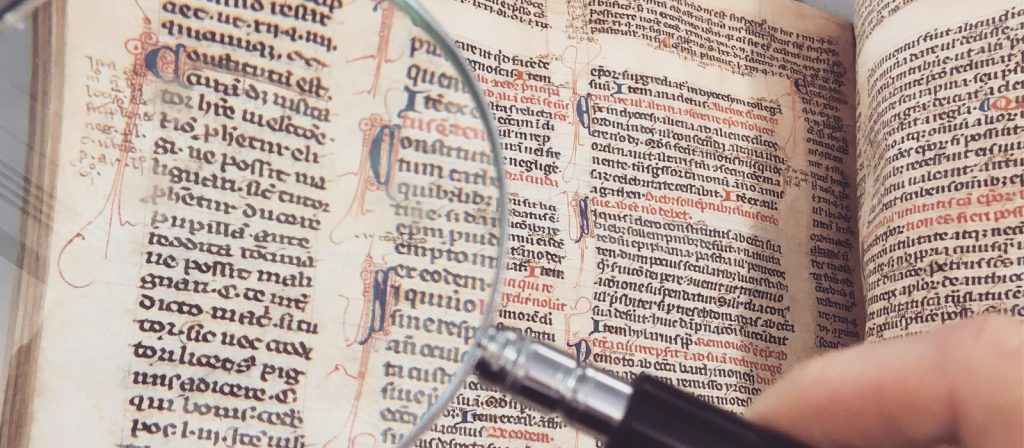
Before paper became widespread in Europe, many manuscripts were produced using parchment manufactured from animal skin. A medieval parchment page is therefore not simply an historical artefact. It is preserved biological tissue.
Previous research had already demonstrated the extraordinary molecular information contained within parchment. Work on the approximately 1,000-year-old York Gospels, for example, showed that minimally invasive sampling could recover animal DNA and other biological information from its pages.[2]
The new sheeppox research takes that idea significantly further. Researchers detected SPPV DNA in parchment associated with manuscripts including the York Gospels, the Corpus Glossary and an early copy of the Epistles of St Paul.[1] Documents preserved because of their cultural and historical importance have inadvertently preserved evidence of livestock disease as well. A library can therefore also be a biological archive.
There is a remarkable chain of events behind every one of these sequences: an animal lived; it encountered sheeppox virus; the animal died and its skin was processed; that skin became parchment; a scribe wrote upon it; the manuscript was preserved; centuries passed; scientists sampled biological material remaining within or upon the parchment; DNA was extracted; sequencing generated fragments of genetic information; bioinformatic analysis identified sequences belonging to sheeppox virus; those sequences were compared with other ancient and modern viral genomes; and from that evidence, researchers could begin reconstructing the evolutionary history of a pathogen.
This is an Ancient BioChain in a remarkably literal sense.
Ancient pathogen genomics is fundamentally dependent upon provenance. With modern biological data, we might ask which animal produced a sample, when it was collected, how it was processed and which analytical workflow produced a result. Ancient material introduces additional layers: where was the archaeological specimen excavated, what context surrounded it, how was it dated, which species produced the material; when and where was a parchment manuscript manufactured, are all pages contemporary, could a page have been replaced centuries later, how was the object handled and sampled, and could DNA have been introduced during manufacture, conservation or later handling?
The scientific value of the sequence therefore depends partly upon the evidence surrounding it. A DNA sequence without context can tell us considerably less than a DNA sequence connected to a well-characterised specimen, archaeological context or historically dated manuscript. This is why ancient genomics is not simply a sequencing problem. It is a provenance problem.
The researchers found something particularly instructive: sheeppox virus DNA was not found exclusively on parchment identified as sheep skin. It was also detected on parchment produced from cattle and goats. That does not automatically demonstrate that those animals were infected — the researchers discuss several possible explanations, including cross-species infection, contamination during parchment production, transfer between pages, or the use of animal-derived materials during manufacture or repair. Parchment production itself provides a plausible route for such transfer, because skins could undergo processing together.[1]
That principle extends far beyond ancient DNA. It applies to modern genomic surveillance, veterinary diagnostics, environmental sequencing and almost every other field in which biological data are interpreted as evidence.
Recovering genomes from different periods provides something modern sequencing alone cannot: time. If researchers sequence hundreds of modern viruses, they see genetic diversity as it exists now. Ancient genomes provide earlier points on the evolutionary timeline.
The sheeppox study suggests the major Capripoxvirus lineages diverged thousands of years ago, with the authors’ models placing those divergence events within a broad period overlapping major changes in sheep populations and their movement across Eurasia.[1] The earliest recovered sheeppox genomes already contain important gene-inactivation patterns found in later SPPV, suggesting some of the genetic changes associated with the virus’s evolutionary history occurred surprisingly early. The researchers also report considerable genomic stability across the ancient SPPV material.
Ancient pathogen genomics therefore allows us to ask questions that contemporary surveillance cannot answer alone: when did a pathogen lineage emerge, how rapidly did its genome change, when did particular mutations appear, how did pathogen evolution intersect with animal domestication, migration and trade, were diseases geographically restricted or widely distributed, and did changes in agricultural systems alter opportunities for transmission? These are biological questions, but they are also archaeological and historical ones.
The domestication of animals fundamentally changed human ecology. Humans did not simply create new populations of cattle, sheep, goats, pigs and other domestic species — we created new ecological relationships. Animals were kept at higher densities, populations moved with people, trade connected previously separated regions, and pastoral societies transported livestock across enormous distances. Humans, domestic animals and wildlife increasingly occupied overlapping disease environments, and pathogens were part of that history.
Ancient pathogen genomics gives us a way to investigate it directly. Recent research has begun recovering pathogen genomes from ancient animals, providing evidence relevant to diseases including plague and brucellosis as well as livestock-specific infections.[3] Sheeppox adds another piece to that emerging picture. Rather than treating disease as an occasional interruption to the history of livestock, we can begin examining pathogens as participants in that history.
Perhaps the most exciting implication of the new work is not sheeppox itself. It is where else we might look. Museums contain animal bones and teeth. Archaeological collections contain biological material recovered decades before genomic analysis existed. Natural-history collections contain preserved tissues. Veterinary collections contain pathological specimens. Libraries and archives contain millions of parchment documents produced from animal skins.
Not every specimen will contain useful pathogen DNA. Not every detection will permit reconstruction of a genome. Contamination, degradation and uncertain provenance will remain major challenges. But collectively these collections represent an enormous and largely unexplored biological archive — objects preserved for archaeology, history, art or literature may contain molecular evidence capable of answering questions their collectors never imagined.
This is precisely why ancient pathogens form Stage 2 of The Ancient BioChain. Stage 1 asks what we can recover about the organisms themselves from ancient biological material. Stage 2 adds another biological layer: what was living in them? That means examining ancient pathogen DNA alongside the host, specimen and contextual information from which it originates.
The aim is not simply to catalogue ancient diseases. The interesting question is whether we can construct reproducible chains connecting archaeological or historical specimen → host → pathogen detection → ancient genome → time and place → evolutionary relationship → historical interpretation. As more ancient pathogen genomes become available, these chains could eventually allow us to explore disease across centuries and millennia rather than merely across contemporary outbreaks.
Sheeppox demonstrates that the evidence may survive in unexpected places — sometimes in a tooth buried on the Eurasian steppe, sometimes in an archaeological sheep burial, and sometimes on a page that people have been reading for a thousand years.
The most important lesson may therefore be broader than the history of one virus. Biological material contains layers of information: the genome of the organism itself; DNA from pathogens that infected it; microorganisms associated with its environment; information created by the archaeological or historical context in which the material survives; and another layer created by every scientific process used to recover and interpret those signals.
Preserving those relationships is what turns sequence data into evidence. The sheeppox genomes recovered from ancient sheep and medieval manuscripts show just how long that evidence can survive. Three and a half millennia after some of these animals lived, their biology is still telling us something about the diseases that shaped their world. We are only beginning to learn how to read it.
Sheeppox virus (SPPV) is a member of the genus Capripoxvirus, alongside goatpox virus and lumpy skin disease virus. It causes fever, skin lesions, internal disease and can be fatal in sheep, and remains an economically significant livestock disease today.
Before paper became widespread, many manuscripts were written on parchment made from animal skin. Parchment is therefore preserved biological tissue, and researchers were able to recover viral DNA from parchment associated with manuscripts including the York Gospels.
The researchers report 21 novel ancient sheeppox genomes with evidence extending back approximately 3,700–3,800 years, taking the molecular history of the virus into the Bronze Age.
Not necessarily. The researchers found SPPV DNA on parchment made from cattle and goat skin as well as sheep skin, and consider contamination during parchment production, transfer between pages, or shared manufacturing processes as more likely explanations than cross-species infection in every case.
A DNA sequence on its own tells you the molecule is present. Understanding why it is present — which animal, which historical context, how the specimen was handled — requires reconstructing the specimen’s full history. That is a provenance problem, not just a sequencing one.
Yes. Sheep pox and goat pox are classified as Category A diseases under the EU Animal Health Law, meaning any outbreak triggers immediate eradication measures. A significant outbreak across Greece and Bulgaria in 2024–2025 led EFSA to publish a 2026 assessment of vaccination strategies.
The Ancient BioChain’s first stage works with genomic information preserved in ancient biological material. This research is the model for Stage 2: extending that work to the pathogens preserved alongside their hosts, and the provenance chain connecting specimen, host, pathogen and historical context.
No. This article describes published third-party research and the direction Stage 2 of The Ancient BioChain is intended to take. It is not a claim that The BioChain has built or deployed an ancient-pathogen research pipeline.
If your organisation generates, manages, analyses or governs biological evidence and would be interested in participating in a UK or European provenance demonstrator, The BioChain would welcome the conversation.
Get in touch

Regulatory developments, technical notes and platform news — sent occasionally, straight to your inbox.